
What Canadian Law Firms should expect from a Trust Bank Account
Trust accounting compliance in Canada depends on more than accurate bookkeeping and legal accounting software. The capabilities provided by your bank can significantly impact your firm’s ability to comply with Law Society requirements, complete monthly reconciliations, retain records, and prepare for audits.
Whether your firm operates in Ontario, British Columbia, Alberta, or another Canadian jurisdiction, your trust account should actively support Canadian legal trust compliance, not create additional administrative work.
Before selecting a trust banking provider, law firms should evaluate whether the institution supports the operational requirements imposed by provincial regulators, including the Law Society of Ontario (LSO) By-Law 9, Law Society of British Columbia (LSBC) Rules 3-58 through 3-75, and the Law Society of Alberta (LSA) Rule 119 framework.
Written by Knowledge Team, posted on September 26, 2026
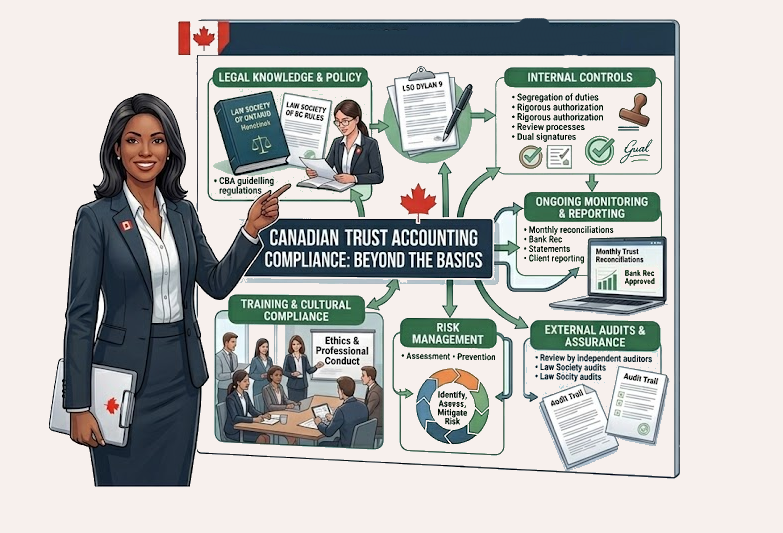
Trust Bank Account Compliance Checklist
| Requirement | Why It Matters |
|---|---|
| Automatic Law Foundation Interest Remittance | Supports provincial trust interest obligations and reduces compliance risk |
| Historical Cheque Images | Required during audits, investigations, and reconciliations |
| Online Statement Archive | Ensures long-term access to required trust records |
| Permanent Transfer Confirmations | Supports trust-to-general transfer reviews and audits |
| Read-Only Bookkeeper Access | Improves segregation of duties and reconciliation processes |
| Three-Way Trust Reconciliation Support | Required for monthly trust accounting compliance |
| Long-Term Record Retention | Supports Law Society audit and record retention requirements |
| Approved Financial Institution Status | Required in many jurisdictions for trust account operation |
Why Your Trust Bank Matters
Every Canadian law firm that handles client funds must maintain accurate trust accounting records, preserve supporting documentation, perform monthly reconciliations, and demonstrate compliance during Law Society reviews.
For example:
- The Law Society of Ontario By-Law 9, Section 18 requires firms to maintain trust receipts journals, trust disbursement journals, client trust ledgers, and trust transfer records.
- The Law Society of British Columbia Rules 3-68 through 3-75 prescribe trust accounting records, monthly trust reconciliations, and retention requirements.
- The Law Society of Alberta Rule 119 framework requires prescribed financial records, trust journals, trust ledgers, trust transfer reports, and monthly reconciliations.
A bank that cannot provide historical records quickly can create significant compliance challenges.

1. Automatic Law Foundation Interest Remittance
In Ontario, pooled trust account interest is remitted to the Law Foundation of Ontario. Similar arrangements exist across Canada to fund legal aid, law reform, and access-to-justice initiatives.
This process should be established automatically when the trust account is opened.
Law firms should not need to:
- Calculate interest manually
- Initiate remittances
- Track payment schedules
- Verify periodic submissions
The best trust banking providers handle these obligations automatically while maintaining appropriate audit records.

2. Access to Historical Cheque Images
Law Society auditors routinely request supporting documentation for transactions that occurred years earlier.
Banks should provide:
- PDF statements with cheque images
- Historical cheque image archives
- Certified cheque copies
- Long-term retention of cheque records
The Law Society of Ontario specifically notes that financial institutions may not retain records for the periods required by By-Law 9 and recommends ensuring copies of negotiated cheques are available as part of monthly records.
If obtaining a cheque image requires multiple requests or branch visits, the bank is creating unnecessary compliance risk.

3. Automatic Online Statement Delivery
Monthly statements are foundational trust accounting records.
A trust banking package should automatically include:
- Monthly PDF statements
- Historical archives
- Secure electronic delivery
- Long-term access
Firms should never discover during an audit that statements were unavailable because online delivery was not activated.

4. Permanent Transfer Confirmation Records
Trust-to-general transfers receive substantial scrutiny during audits.
Banks should permanently retain:
- Transfer confirmations
- Wire confirmations
- Electronic banking records
- Internal transfer receipts
- Transaction references
LSO audit guidance specifically requires firms to retain electronic trust transfer requisitions and confirmations supporting trust transfers.
Permanent transfer records are essential for demonstrating compliance.

5. Read-Only Access for Bookkeepers
Many firms rely on external legal bookkeepers and controllers to complete monthly trust accounting reviews.
A modern banking platform should allow authorized users to:
- Review trust transactions
- Access transfer details
- Verify deposits and withdrawals
- Support reconciliations
This improves internal controls and segregation of duties while maintaining security.

6. Support for Three-Way Trust Reconciliations
One of the most important monthly trust accounting controls is the three-way trust reconciliation.
Legal administrators frequently search for three-way trust reconciliation software because this process is mandatory and time-consuming when performed manually.
A proper reconciliation confirms:
Adjusted Trust Bank Balance
=
Trust Journal (Control Account) Balance
= Total Client Trust Ledger Balances
Or:
Bank Statement Balance
+ Outstanding Deposits
– Outstanding Cheques
——————————– Adjusted Trust Bank Balance

Must Equal
Trust Journal Balance
Must Equal
Sum of Client Trust Ledgers
The Law Society of British Columbia requires monthly trust reconciliations under Rule 3-73, while Alberta’s Rule 119 framework similarly requires monthly reconciliation and supporting records.
Without timely statements, cheque images, and transfer records from the bank, completing this reconciliation becomes unnecessarily difficult.

7. Long-Term Record Retention
Trust accounting records must be retained for extended periods.
Examples include:
| Jurisdiction | Retention Requirement |
|---|---|
| Ontario | Trust records generally retained for 10 years; certain general accounting records for 6 years under By-Law 9 Section 23. |
| British Columbia | Trust accounting records and monthly trust reconciliations retained for at least 10 years under Rule 3-75. |
| Alberta | Prescribed financial records must be retrievable on demand for a minimum of 10 years under Rule 119.35. |
| Permanent Transfer Confirmations | Supports trust-to-general transfer reviews and audits |
| Read-Only Bookkeeper Access | Improves segregation of duties and reconciliation processes |
| Three-Way Trust Reconciliation Support | Required for monthly trust accounting compliance |
| Long-Term Record Retention | Supports Law Society audit and record retention requirements |
| Approved Financial Institution Status | Required in many jurisdictions for trust account operation |
8. Approved Financial Institutions Matter
When evaluating trust banking options, firms should confirm that the institution satisfies Law Society requirements for lawyer trust accounts.
Many legal administrators search for approved financial institutions Law Society Ontario or similar terms when opening new trust accounts.
A bank that regularly services law firms typically understands:
- Trust account designation requirements
- Law Foundation reporting requirements
- Interest remittance obligations
- Audit support requirements
- Trust documentation retention expectations
Experience with legal trust accounting can significantly reduce administrative issues later.

How PageLightPrime Helps
Even when a bank provides strong trust accounting support, firms still need a centralized platform to manage trust transactions, client matters, reconciliations, supporting documents, and audit reporting.
PageLightPrime is a Microsoft 365-native legal accounting software and practice management platform designed specifically for Canadian law firms.
With PageLightPrime, firms can:
- Some of that content may be essential.
- Some may be obsolete.
- Some may be duplicated.
- Some may no longer have a clear owner.
- Generate Law Society-ready trust reports
- Store statements, cheque images, and transfer confirmations in SharePoint Online
- Support Canadian legal trust compliance requirements
- Maintain complete audit trails within Microsoft 365
Because documents remain within the firm’s own Microsoft 365 tenant, firms retain full ownership and control of their trust accounting records while benefiting from Microsoft SharePoint Online, Microsoft Entra ID, Microsoft Purview, and long-term retention capabilities.

“
The Bottom Line
Trust accounting should not become more difficult because of banking limitations.
The best trust account providers help Canadian law firms maintain compliance by offering:
- Automatic Law Foundation interest remittance
- Historical cheque image access
- Online statement archives
- Permanent transfer confirmations
- Read-only access for accounting personnel
- Support for three-way trust reconciliations
- Long-term record retention
- Familiarity with Law Society trust requirements
When combined with a legal accounting platform such as PageLightPrime, these capabilities create a stronger foundation for compliance, audit readiness, operational efficiency, and client trust.
A trust account should do more than hold funds—it should actively support your firm’s trust accounting obligations every day.

“
FAQ: Frequently Asked Questions
What happens if a trust reconciliation does not balance?
A trust reconciliation discrepancy should be investigated immediately. Law firms must identify the cause, correct errors, document adjustments, and maintain supporting records.
Can a law firm use a regular business account instead of a trust account?
No. Client funds must generally be held in a designated trust account to meet Law Society requirements.
How often should trust accounts be reconciled?
Most Canadian jurisdictions require monthly trust reconciliations.
What is a three-way trust reconciliation?
A three-way trust reconciliation confirms that:
- Adjusted trust bank balance
- Trust journal balance
- Total client trust ledger balances
all matches.
How long must trust accounting records be retained?
Depending on jurisdiction, trust accounting records are generally retained for six to ten years, with many trust records requiring ten-year retention.